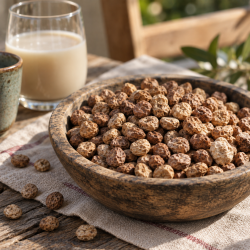
Organic activated buckwheat seeds
Dehydrated sprouted buckwheat seeds (=activated), organic
500g bag
No queries yet, leave the first!
Price:
€21.90
Product availability:
In stock
Tax included


Organic activated buckwheat seeds images


Organic sprouted buckwheat - activated and dehydrated at 42°C
You like buckwheat but are not quite sure how to make it part of your daily routine? You want to eat it raw, without cooking, without having the time to sprout it yourself? Honestly, that is exactly why we created this product.
Our sprouted buckwheat is activated in very pure, dynamised water, then dehydrated at 42°C. You get small sprouted grains, crunchy and ready to eat - to slip in anywhere, in sweet and savoury dishes alike.
🌱 Dehydrated sprouted buckwheat or sprouting seeds: what is the difference?
This product is already activated, sprouted and then dried : no preparation, it is eaten as is. If, on the other hand, you prefer to sprout your grains yourself, discover instead our buckwheat seeds for sprouting. In concrete terms, the two complement each other: one for spontaneity, the other for the pleasure of tending your own sprouter.
🌱 What is activation?
It is the soaking of seeds or nuts, which awakens the seed's enzymatic activity and starts germination. Home-activated seeds, however, keep for only a few days in the fridge: so we dehydrate them at low temperature, to combine activation, optimal keeping and a crunchy texture. To go further: why sprout your seeds and what is a bioactive diet.
Activated buckwheat is thus an awakened seed, on its way to germination: its reserves (fats, proteins, complex sugars) begin to be broken down into fatty acids, amino acids and simple sugars.
🌱 How do you use sprouted buckwheat? Here are a few ideas:
- as a crunchy topping on a yoghurt (plant-based or not), a porridge or a compote;
- in a muesli or raw granola, mixed with dried fruit;
- to add crunch to a salad, a buckwheat tabbouleh or a cold soup;
- in raw pastries, energy bars or crackers.
🌱 Spotlight on buckwheat
Buckwheat (or "black wheat") is not a cereal: it is the seed of a flowering plant (Fagopyrum esculentum), from the sorrel family. Originating in Asia, it has been used for thousands of years in a wide variety of forms: buckwheat galettes in Brittany, soba noodles in Japan, kasha in Russia. Growing it is also good for the soil: in organic farming, it is used to smother weeds and enrich the soil with phosphorus. Naturally gluten-free and peanut-free, it is an interesting alternative for people who are gluten intolerant.
Process: bath in reverse-osmosis, dynamised water for 6 hours, then dehydration for 20 hours at 42°C.
💬 "I eat dehydrated sprouted seeds every day." - Marion, customer review ⭐⭐⭐⭐⭐
🌱 The main nutritional assets of buckwheat
• Source of protein : 13.5 g of protein per 100 g, i.e. around 15% of the energy intake (see the nutritional values in the Practical info tab). Buckwheat provides most of the essential amino acids in good proportions, notably lysine - often the limiting one in cereals.
• Naturally gluten-free : a first-rate alternative for people who are intolerant or coeliac.
• Flavonoids and phenolic compounds : buckwheat naturally contains flavonoids (rutin, quercetin, orientin, vitexin...) and phenolic acids.
• High in fibre : 9.4 g of fibre per 100 g, including a share of insoluble fibre.
• High in magnesium : 231 mg per 100 g, i.e. 62% of the nutrient reference values. Magnesium contributes to normal energy-yielding metabolism and to a reduction of tiredness and fatigue*.
* Magnesium contributes to normal energy-yielding metabolism and to a reduction of tiredness and fatigue, as part of a varied, balanced diet and a healthy lifestyle.
CROC'ENVIE
Based in Brittany, in Ploemeur, Armand devotes himself to producing really good raw foods. He tries to source his ingredients in Brittany (such as seaweed, hemp or spirulina) and works with local partners for products that come from far away. So it was only natural that an exclusive collaboration came about with Biovie. Armand explains his background:
"I became interested in living food early in my life, in my twenties, after reading the book "The Biogenic Way" by Edmond Szekely. At that time, I was practising yoga intensively and I wanted to understand the principles of a harmonious diet. I became passionate about activating and sprouting seeds. I create blends that make it easy to prepare instant preparations to combine with raw fruit and vegetables, making the transition to living food easier. My 7 years of experience as a restaurateur gave me the skills to set up a food production workshop. I develop my recipes with high standards; the pursuit of taste and texture is obviously at the very heart of my approach. I regularly run workshops in my workshop on plant milks, sprouted seeds and lacto-fermentation." We recommend you drop in on him if you are near Plœmeur!
Best before: 12/05/2027
- Best before : 12 months after the production date
- Storage : in a cool, dry place, in the tightly closed bag or an airtight jar
- Packaging : 100% recyclable kraft bag
- Origin : France or Poland (depending on climatic conditions). Made in France, in Brittany.
Average nutritional values (per 100 g)
- Energy: 1498 kJ / 354 kcal
- Fat: 3.3 g (of which saturates: 0.6 g)
- Carbohydrate: 63 g (of which sugars: 2.3 g)
- Fibre: 9.4 g
- Protein: 13.5 g
- Salt: 0 g
- Magnesium: 231 mg
- Precautions : buckwheat is a recognised food allergen - avoid if you are allergic to buckwheat. If you are pregnant or breastfeeding, as data are limited, ask a healthcare professional for advice.
❓ Frequently asked questions
What does sprouted buckwheat contain?
Sprouted buckwheat is naturally gluten-free. It provides 13.5 g of protein, 9.4 g of fibre and 231 mg of magnesium per 100 g (see the nutritional values above), and naturally contains flavonoids such as rutin.
What is the difference between sprouted buckwheat and buckwheat seeds for sprouting?
Our sprouted buckwheat is already activated, sprouted and then dehydrated: it is eaten as is, with no preparation. The sprouting seeds are raw and intended to be soaked and then sprouted at home.
Can sprouted buckwheat be eaten raw?
Yes. Dehydrated at low temperature (42°C), it stays raw and crunchy: it is eaten straight away, without cooking, as a topping, in muesli, salad or raw pastries.
How do you use dehydrated sprouted buckwheat?
As a topping on a yoghurt, a porridge or a compote, in a muesli or a raw granola, to add crunch to a salad or a tabbouleh, or in energy bars and crackers.
Does sprouted buckwheat contain gluten?
No. Buckwheat is naturally gluten-free and peanut-free, which makes it an interesting alternative for people who are intolerant or coeliac.
How do you store sprouted buckwheat?
In a cool, dry place, in the tightly resealed bag or an airtight jar. The best-before date is 12 months after the production date.
Updated: July 2026. Product page approved by Éric Viard, founder of Biovie and ISTOM, co-author of "Algues au quotidien" (Gallimard, 2024) - Best Cookbook in the World, Gourmand Cookbook Awards 2025, and Best Cookbook in France, Académie Nationale de Cuisine 2025.
Information given for guidance only. This product is a food and is not a substitute for a varied and balanced diet or for medical advice. As part of a varied, balanced diet and a healthy lifestyle.
Wondering… ?
Everything you need to know before ordering.
Be the first to ask a question about this product!
Question about the product
Ask a question