Plant-based milk is a milk extracted from a plant: a cereal, legume, nut or seed, or tuber, depending on the case. It is an alternative to animal milk containing neither lactose nor casein, compatible with a vegan diet, which helps avoid food intolerances to dairy products. As part of a varied and balanced diet, homemade plant-based milks have their place alongside other sources of calcium and protein.
In this article, I give you eight recipes to make at home: almond, hazelnut, cashew, tiger nut, coconut, oat, hemp and sesame, with the quantities, soaking time, straining method and storage for each one. Enough to never buy a carton out of habit again.
Cartons of pasteurised plant-based milk have neither the same taste nor the same nutritional content as the one you make at home. These industrial milks go through a pasteurisation that destroys all the enzymes as well as the phytonutrients and heat-sensitive vitamins, which are degraded by heat above 43°C. At home, nuts soaked overnight are also much more digestible than dry ones, and you use a much larger quantity of ingredients than industrial milks do: read the labels, the amounts of almonds, rice or hazelnuts will surprise you.
The composition: read the label on a carton
A homemade almond milk contains two ingredients: almonds and water. A store-bought carton often shows only 2 to 7% almonds, topped up with water, an emulsifier, a stabiliser, sometimes sugar or a flavouring. That is the first shock when you compare labels: the price per litre seems reasonable, but you are mostly buying water.
The honest flip side: industrial milks are frequently fortified with calcium, vitamin D and B12, which your homemade preparation does not provide. For a person who relies on these intakes, a strict vegan diet for example, it is not a detail, and it deserves to be made up for elsewhere on the plate.
The heat treatment
Cartons are pasteurised, often at ultra-high temperature, to keep for several months at room temperature. Above 43°C, enzymes are destroyed and heat-sensitive vitamins degrade: this is precisely what we seek to preserve in living food. A homemade milk is drunk fresh, within two to three days, and has never seen heat.
The real cost, calculated per litre
Allow about 100 to 200 g of nuts and seeds for one litre of homemade milk depending on the recipe. This comes to a cost comparable to, or even lower than, a quality organic carton, with ten to twenty times more nuts in the glass. The equation becomes clearly favourable if you recover the okara (the strained pulp) for your cookies, crackers or raw tart bases: nothing is wasted.
Time, the real issue
This is where the shop wins, no point denying it: opening a carton takes three seconds. Making a litre of homemade milk takes an overnight soak and five minutes in the morning, blending, straining through the milk bag, cleaning included. So the question is not "which one is better?" but "what are you ready to invest?". For us, the answer has been: homemade on weekdays for everyday uses, a carton in the cupboard as a backup for rushed days. There is no contradiction in doing both.
The equipment to make plant-based milk at home
No need for a full workshop: three tools are enough, and you may already have at least one in a cupboard.
The powerful blender is the central tool of the whole recipe. A standard blender struggles to grind soaked nuts finely, which leaves a grainy texture and a lower yield, as the pulp keeps too much milk trapped inside. A powerful blender such as the Hurom Power grinds finely in 1 to 2 minutes, which gives a smoother milk and a drier pulp, so less waste. It is an investment that is also useful for smoothies, raw soups and spreads, not only for plant-based milk.
The plant milk bag is the simplest and most durable straining tool. Our fine-mesh fabric plant milk bag is rinsed in clear water after use, occasionally machine washed, and lasts for years, unlike a cheesecloth or a cotton muslin, which have a more limited life and tend to let more fibres through over time. Press the bag firmly to extract as much liquid as possible: this is where a good part of your recipe's yield is decided.
A juicer (such as our Hurom E30ST) is an interesting alternative to the blender for some recipes, notably coconut milk from fresh flesh: the auger presses the material at low speed, which limits heating and oxidation, and separates the milk from the pulp directly without going through a bag. It is slower than a blender, but the result is often finer.
For upkeep, rinse the milk bag and the blender bowl immediately after use: dried pulp sticks and becomes harder to remove once hardened. A small accessory that changes daily life: a soft brush to clean the bottom of the bowl and the mesh of the bag without damaging them. Over time, the investment in a good blender or a quality milk bag pays for itself quickly: compared with the cumulative price of store-bought cartons over a year, the difference shows from the first months, not to mention the pleasure of fully controlling what is in your glass.
For the rest, a large bowl for soaking, a fine strainer for a first draining before the bag, and a glass bottle for storage in the refrigerator are more than enough. None of these items is compulsory to get started: a standard kitchen blender and a fine strainer already give good results, simply with a little more residue in the glass.
Comparison table of plant-based milks
To choose quickly according to your tastes and needs, here are the eight milks presented in this article, compared on the criteria that matter day to day.
Milk
Taste
Texture
Homemade cost/L
Store-bought cost/L
Straining
Storage
Use
Almond
Mild, slightly sweet
Fluid
About €2.50 to 3.50
About €2 to 3
Milk bag, compulsory
3 to 4 days
Baking, coffee, drinks
Hazelnut
Toasted, indulgent
Fluid, a little rich
About €3 to 4
About €2.50 to 3.50
Milk bag, compulsory
3 to 4 days
Desserts, hot chocolate
Cashew
Mild, discreet
Creamy, smooth
About €3 to 4
About €3 to 4
Optional (very fine as is)
3 days
Sauces, creams, velouté soups
Tiger nut
Sweet, almond and hazelnut notes
Fluid
About €1.50 to 2
Rarely sold in cartons
Milk bag, compulsory
3 to 4 days
Golden drinks, everyday use
Coconut (fresh flesh)
Exotic, fragrant
Rich, smooth
About €4 to 5
About €3 to 4
Optional depending on the blender
2 to 3 days
Curry, exotic cooking, desserts
Oat
Sweet, cereal-like
Thick
About €0.50 to 1
About €1.50 to 2
Milk bag, compulsory
2 to 3 days
Breakfast, porridge, coffee
Hemp
Neutral, slightly grassy
Fluid
About €3 to 4
Rarely sold in cartons
Optional (hulled seeds)
2 to 3 days
Smoothies, light drinks
Sesame
Pronounced, toasted
Fluid
About €2 to 3
Rarely sold in cartons
Milk bag, compulsory
2 to 3 days
Middle Eastern cooking, sauces
Indicative costs, calculated on current organic prices at the time of writing, they vary by shop and season. The homemade cost includes only the main ingredient and water, not the amortisation of the equipment.
Our 8 homemade plant-based milk recipes
For all these recipes, the basic method is similar: soaking, blending with water, straining through the plant milk bag. Here is what changes from one base to another.
Storage: 3 to 4 days. It is the most economical milk on this list, tiger nuts cost about half as much as almonds or hazelnuts, and it is one of the most digestible.
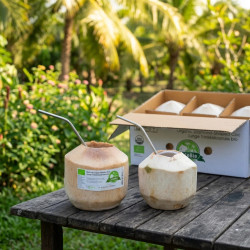
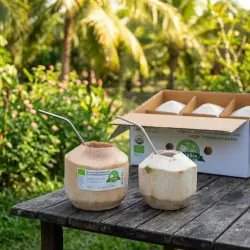
Open the coconut and collect the coconut water, very fragrant, to drink as it is or to use in another recipe.
Collect the white flesh and weigh out 250 g.
Put the pieces of coconut in the blender with the spring water.
Blend for 2 minutes, until you get a fluid milk with no pieces.
Store in the refrigerator and mix well before each use.
Storage: 2 to 3 days. Add some cinnamon or ginger to lift the taste.
Oat milk
80 to 100 g of rolled oats
1 litre of cold water
Soak the oats for only 20 to 30 minutes in cold water, no longer, or you will end up with a slimy milk.
Rinse abundantly with cold water to wash away the surface starch, responsible for this gluey texture.
Blend quickly, 20 to 30 seconds at most, with cold water.
Strain immediately through the plant milk bag, without pressing too hard so as not to bring the starch back up.
Store in the refrigerator.
Storage: 2 to 3 days. An important point: raw oats are not the most digestible cereal without a minimum of preparation. If you find them hard to digest as they are, a variation is to gently heat the mixture for 1 to 2 minutes before straining, you then leave the raw register, but you gain in digestive comfort. It is up to you to choose according to your tolerance.
Hemp milk
60 to 80 g of hulled hemp seeds
1 litre of spring water
No soaking needed: hulled hemp seeds are already tender.
Blend the seeds directly with the water, 1 to 2 minutes.
Strain through the plant milk bag if you want a very smooth texture, some prefer to drink it unstrained, richer in fibre.
Store in the refrigerator.
Storage: 2 to 3 days. A neutral milk that is quick to prepare, ideal as a smoothie base.
Sesame milk
60 g of sesame seeds (or 2 to 3 tablespoons of whole sesame paste)
1 litre of spring water
Soak the sesame seeds for 6 to 8 hours.
Drain and rinse.
Blend with the water for 1 to 2 minutes.
Strain through the plant milk bag, sesame leaves more residue than cashew or hemp.
Store in the refrigerator.
Storage: 2 to 3 days. Its pronounced, toasted taste goes particularly well with the sweet and savoury preparations of Middle Eastern cooking.
Plant-based milks, thanks to their mild flavour, offer many possibilities in organic and living cooking. They can be used as an ingredient to make smoothies, raw agar-agar flans, creams, coulis, a raw soup or a sauce base. You can also use them to make a golden milk (with turmeric, pepper, ginger and cinnamon), or a plant-based milk with raw cacao.
Which plant-based milk is best suited to your needs?
The best plant-based milk depends mostly on what you are looking for:
For flavour: tiger nut, almond and hazelnut are the most appreciated, with a taste very close to the nut or seed used.
For exoticism: fresh coconut milk remains the most nourishing and the most fragrant.
For calcium: almond is the richest among homemade milks.
For protein: hazelnut, oat and hemp provide the most, even though all plant-based milks remain less rich in protein than cow's milk.
For the best nutritional quality to price ratio: tiger nut, unbeatable on homemade price, for great nutritional quality.
None of these milks contains lactose or casein, two components sometimes associated with disorders of the intestinal flora or with increased intestinal permeability in some sensitive people. As part of a varied and balanced diet, varying plant-based milks according to the recipes remains the best approach: each has its strengths.
Plant-based milk FAQ
How long does homemade plant-based milk keep?
Between 2 and 4 days in the refrigerator depending on the recipe, against several weeks for a pasteurised industrial milk: this is the logical flip side of the absence of heat treatment.
Do you necessarily need a powerful blender?
No, a standard kitchen blender works, but a powerful blender such as the Hurom Power grinds more finely and improves the yield, you lose less material in the strained pulp.
Does homemade plant-based milk contain as much calcium as an industrial milk?
No: industrial milks are often fortified with calcium, vitamin D and B12, which a homemade preparation does not provide by itself. Remember to make up for these intakes elsewhere in your diet if you follow a strict vegan diet.
Can you freeze homemade plant-based milk?
Yes, most freeze well for 1 to 2 months, in an airtight container. Remember to stir well after thawing, some milks tend to separate slightly.
Disclaimer: the information presented in this article is provided for information purposes only and does not constitute medical advice. Consult a qualified healthcare professional before making any change to your diet or supplementation. As part of a varied and balanced diet and a healthy lifestyle.