Birch sap: composition, harvest, storage and consumption advice
Birch sap is a spring drink. This translucent liquid, harvested directly from the trunk of the tree when nature wakes up, has been drunk for centuries in the Nordic countries.
For several years we have been offering on Biovie an exceptional organic fermented birch sap, harvested in the Pyrenees by La Sève Cathare. Today I share with you everything you need to know to choose it, store it and consume it well.
Searches for "birch sap" explode every March, with a peak of 90,500 monthly queries. Needless to say, the subject interests you, and rightly so.
Birch sapis the nourishing liquid that rises from the roots to the branches at the time of the thaw, generally between February and April. As a reminder, the rising sap of trees taken up by the roots is for the most part water loaded with nutrients, about 98% water. But it is in the remaining 2% that things become really interesting.
Birch sap, birch water, birch juice: what is the difference?
Be careful, there is a frequent confusion on this subject. Birch sap (or "birch water" in the Nordic tradition) is the raw liquid harvested through a small incision in the trunk. Birch juice, on the other hand, is obtained by decoction or infusion of the leaves and bark: it is a very different product. Birch water, for its part, often refers to the same thing as sap in everyday language.
Concretely, when we talk about birch sap, we mean this raw sap, harvested directly from the tree. And the difference then lies in the method of preservation: the sap can be consumed fresh (in the days following the harvest), pasteurised or fermented.
It is lacto-fermentation that particularly interests us at Biovie, because it allows the sap to be kept at room temperature for two years. If you would like to go deeper on this point, we have a dedicated article on fermented birch sap that details the fermentation.
Composition: what the sap contains
Behind its appearance of clear water, the sap contains in particular:
17 amino acids including asparagine, glutamine, arginine, serine and glycine
Minerals : in small quantities, the detail of which is given on the product data sheet
Betuloside : a compound specific to birch, a precursor of methyl salicylate (this is the reason for the precaution for people allergic to salicylate derivatives)
According to the study by Grabek-Lejko et al. published in Baltic Forestry, the composition of the sap varies according to the tree's habitat, one more reason to choose a sap harvested in a preserved environment.
Let us now move on to practice: how much, when, and in what form.
How much per day?
The usual quantity is 15 cl per day, i.e. a small glass, most often in the morning before breakfast. There is no need to drink more.
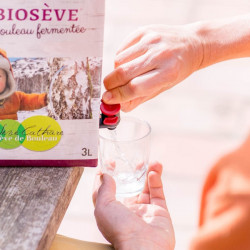
The 3-litre BIB (Bag-In-Box) format that we offer at Biovie corresponds to 20 glasses of 15 cl, i.e. about three weeks at one glass per day.
To start : if you have never drunk it, start with half a glass (about 7 cl) for the first few days, long enough to get used to its taste and check that it suits you, then gradually move up to 15 cl.
When to drink it? (spring, autumn, all year round)
Spring remains the traditional season for birch sap, and it is no coincidence: it is the time when the sap runs in the birches.
That said, thanks to lacto-fermentation, our sap keeps at room temperature with a best before date of 2 years: you are therefore not limited to one season.
Where the sap comes from: how the harvest works
The cure is talked about a lot, the gesture that makes it possible rarely. Yet it explains the seasonality of the product and a good part of its price.
The sap rises in the birch at the end of winter, when the tree rebuilds the pressure needed to supply the coming buds. Depending on the region and the year, the window opens between January and March, after the hard frosts and as soon as the sun returns, never on a fixed date: it is the tree that decides, and a late spring shifts the whole harvest.
The tapping itself is simple in principle. The trunk is drilled a few centimetres deep, a tube connected to a closed container is inserted, and the sap flows by itself, without a pump or pressure. An adult birch yields a few litres a day, and you never take everything that rises: the tree keeps what it needs to leaf out.
If you have birches at home and would like to try, two precautions are worth recalling. Only tap a well-established tree, and carefully plug the cut after the harvest so that the wound closes cleanly. A tree that is poorly cared for after tapping closes badly, and the pleasure of a glass of sap is not worth the health of a birch.
This is also what explains the difference between fresh sap and stabilised sap discussed below: the harvest lasts a few weeks a year, whereas demand lasts all year.
Fresh or stabilised sap: which to choose?
This is a question that comes up constantly. Here is an honest comparison of the different forms of birch sap:
Fresh sap : this is the sap as it comes out of the tree, but it must be consumed in the days following the harvest and needs to be kept in the refrigerator. It is seasonal and perishable.
Pasteurised sap : long-term storage, but pasteurisation heats the sap and changes some of its components and its taste. This is the main compromise.
Fermented sap (our choice at Biovie): lacto-fermentation allows long-term storage at room temperature, without heating the sap, and gives it a slightly tangy flavour. The pouring cap of the BIB prevents air from getting in, which preserves the sap once opened.
Clearly, it is fermented sap that offers, in our eyes, the best compromise between quality and convenience. Our organic fermented birch sap (La Sève Cathare) is harvested from wild birches at 900 metres altitude in the Pyrenees, certified Nature & Progrès, a label even more demanding than European organic. It also exists in the fermented blackcurrant version, which Carmen S. found in her April 2024 review "pleasant to drink, sweet and very slightly acidic".
Birch sap: contraindications and side effects
I want to approach this subject with transparency, because that is exactly what you are looking for and it matters. At Biovie, we always prefer transparency to an easy sale.
Contraindications to know
Birch sap is not recommended in the following cases:
Kidney failure : as a precaution, ask your doctor for advice before drinking it.
Allergy to salicylate derivatives : betuloside is a precursor of methyl salicylate. If you are allergic to aspirin, be careful.
Pregnancy and breastfeeding : as a precaution, consult your doctor or your midwife.
Anticoagulant treatment : salicylate derivatives may interact with certain anticoagulant treatments.
In all cases, if you are following a medical treatment (including for blood pressure), consult your doctor before consuming it regularly. We are not authorised to give therapeutic advice: this is a rule we hold to at Biovie.
Possible side effects (and how to manage them)
The most common side effects of birch sap are mild and temporary:
Faster transit in the first few days in some people: start with half a glass to let your body adapt.
These effects generally disappear within 2 to 3 days. If they persist, reduce the dose and consult a healthcare professional.
Affiches encadrées et images vectorielles, tout ce dont vous avez besoin pour donner de la personnalité à vos murs ou donner vie à vos projets créatifs., 49
products
Birch sap is made up of about 98% water. It also contains 17 amino acids, minerals in small quantities and betuloside, a compound specific to birch, a precursor of methyl salicylate (hence the precaution for people allergic to salicylate derivatives).
How much birch sap should be drunk per day?
The usual quantity is 15 cl per day, i.e. a small glass. The 3 L BIB format offered by Biovie corresponds to about three weeks at one glass per day. Start with half a glass if you have never drunk it.
What are the contraindications of birch sap?
The sap is not recommended for people with kidney failure, those allergic to salicylate derivatives, pregnant or breastfeeding women and people taking anticoagulants. Consult your doctor if in doubt, in particular if you are following an ongoing medical treatment.
Can birch sap be drunk outside spring?
Fermented sap can be consumed all year round thanks to lacto-fermentation, which allows long-term storage at room temperature. Biovie sap (3 L BIB) has a best before date of 2 years. Spring remains the traditional season for the sap.
What are the possible side effects?
Some people notice faster transit in the first few days. Start with half a glass daily to allow your body to adapt, then gradually increase to 15 cl. If discomfort persists, reduce the quantity and seek advice from a healthcare professional.
In summary
Birch sap is much more than a simple spring trend: it is an ancestral drink, harvested a few weeks a year, which fermentation allows us to enjoy all year round.
Frankly, when you divide the price of a 3 L BIB by three weeks of consumption, it is comparable to the price of a daily coffee.
And there you have it, this presentation is of course not exhaustive: we have other articles on the precautions for use of birch sap that complement this one. Spring is the perfect time to discover it.